
One Size
does not fit all mothers

Here we are, only days away from the infamous Mother’s Day. Robbed of its origins as a rally cry for women opposed to war, it has steeped so long in the lukewarm waters of greeting cards that it has lost much of its flavor.
A quick look back at its American roots:
Julia Ward Howe, best known as the author of the “Battle Hymn of the Republic,” was an abolitionist, a women’s rights advocate, and a peace activist. In 1870, horrified by the death and destruction she had witnessed during the Civil War and concerned by the Franco-Prussian war unfolding abroad, Howe issued what has come to be known as her “Mother’s Day Proclamation,” originally called an “Appeal to womanhood throughout the world …to promote the alliance of the different nationalities, the amicable settlement of international questions, the great and general interests of peace.”
When that didn’t happen, she sought to establish an annual Mother’s Day for Peace, to be celebrated in June. That did happen in a few places, for a while.
Howe gave voice to women as truthtellers and light bearers for the disenfranchised and oppressed, including themselves. It is precisely because they come from similar experiences, they know that efforts to meet social expectations can conflict with knowing and honoring the value of one’s intrinsic worth.
So this Mother’s Day, I’d like to share a few poems that turn away from saccharin sentiments and take us, instead, into the often shadowy inner workings of motherhood (as is mothering/caregiving). Not all women fare well as such. Some embrace it as a choice, others consider it an unintended fate. The following selections reflect circumstances familiar to many.
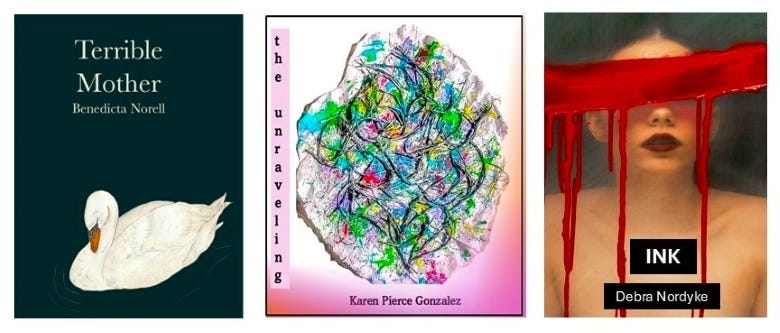
The first poem, written by Benedicta Norell, is the title of her collection, Terrible Mother (Black Cat Poetry Press)
About this piece, she says “I try to capture the grief caused by looking at my mothering through the eyes of my harshest critic. At the same time I want to celebrate the beauty of the true work of care and connection at the core of motherhood, which is so much bigger than society’s judgements.”
Debra Nordyke’s “Ghost” is from her soon-to-be released collection, Ink (Kelsay Books). She notes, “This is about the life of a child whose mother comes home from work every day yet because of her mother’s own emotional barriers is like a ghost.”
And, finally, a prose poem of my own from ‘the unraveling’, a chapbook in progress. “Mothers are human, too, and those who suffer domestic violence are trapped; often unable to tend to their children in ways that are supportive and nurturing.”
Want to get in touch with these poets?
Learn more about the origins of Mother’s Day
Your posts always so fascinating, Karen! Thank you.
Thanks for sharing this — gorgeous poems and I didn’t know about the origins of Mother’s Day!